

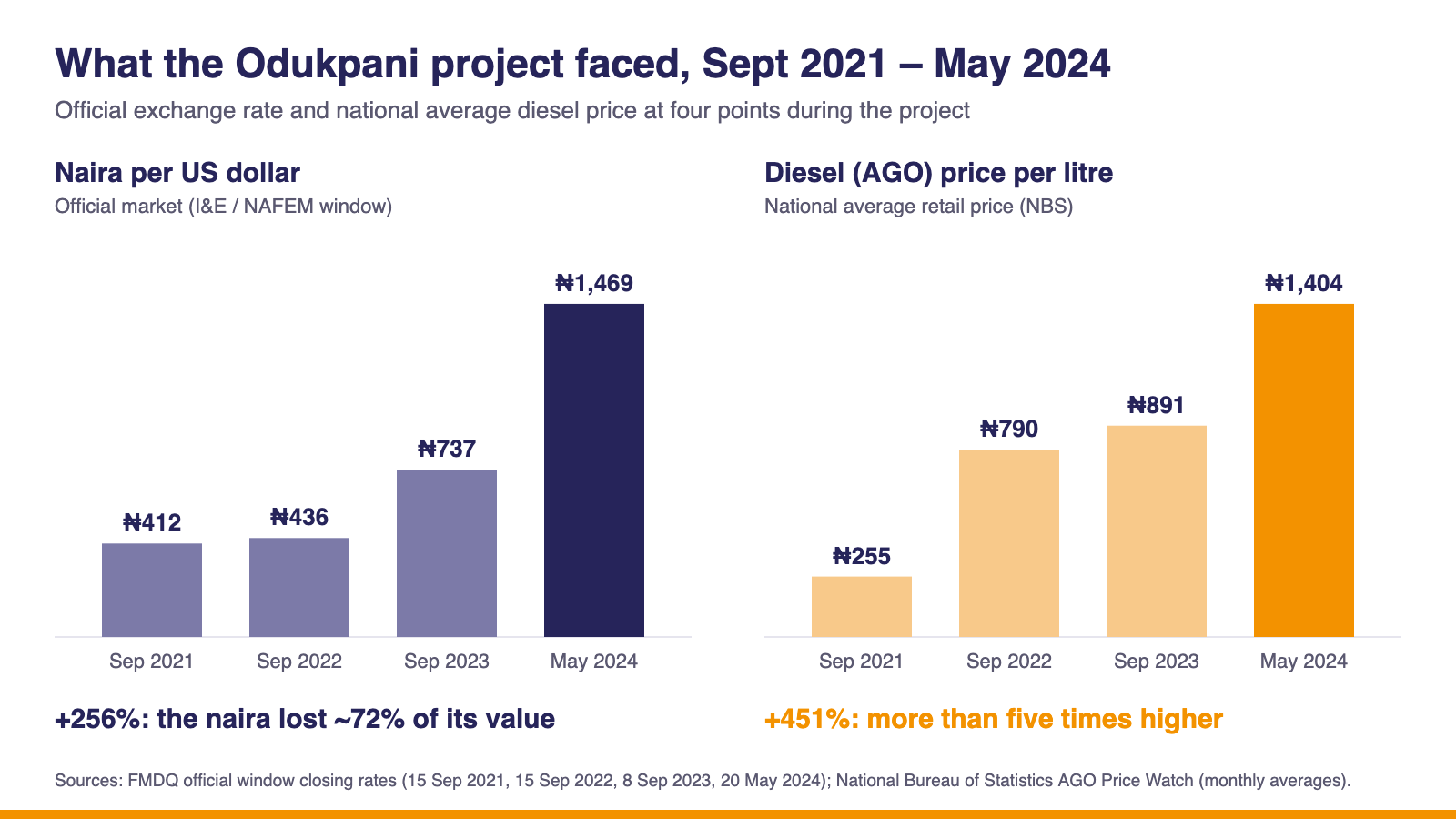
When Opes Manus broke ground on NCDMB’s new manufacturing workshop and warehouse at the Nigerian Oil and Gas Park in Odukpani, Cross River State, in September 2021, a US dollar cost about ₦412 and a litre of diesel about ₦255. By the time the building was completed and handed over in May 2024, the dollar cost about ₦1,469 and diesel about ₦1,404.
Our team delivered the site preparation, foundations and reinforced concrete floor slab for the 5,282m² facility, and kept building materials flowing to site throughout. This is what those price shocks meant on the ground, and why holding the programme is one of the most effective ways to protect a construction budget in Nigeria.
The project
The Odukpani Nigerian Oil and Gas Park is part of NCDMB’s programme to build local manufacturing capacity for the oil and gas industry. The development covers a total construction area of about 5,282m²: a 3,672m² manufacturing shop floor and a 1,302m² warehouse. The shop floor is laid out on a 5m structural grid measuring roughly 70m by 50m, with universal steel columns carrying a long-span steel roof truss clad in aluminium sheeting with translucent and polycarbonate skylights.
Everything above ground depends on what goes in below it. Our scope was to prepare the site and build that foundation: the ground, the column bases that carry the steel frame, and the 150mm reinforced concrete floor slab that the factory will operate on.
What we built, and how
1. Site preparation and earthworks
We cleared and stripped the full 5,282m² site, then excavated around 1,540m³ of trenches and pits for the foundations. Suitable excavated material, about 937m³, went back in as filling; the rest was carted away from site. To bring the floor up to level we imported around 1,430m³ of laterite and 716m³ of stone boulders, placed and compacted in layers to form a 450mm hardcore bed under the slab.

2. Foundations
Each steel column sits on a reinforced concrete pad base with a concrete stub column, set out to the 5m grid. After a 50mm blinding layer, we cast around 205m³ of concrete in column bases, 84m³ in stub columns and 53m³ in strip foundations, with the steel base plates and 20mm holding-down bolts cast in to receive the structural frame. Around 1,220m² of 225mm sandcrete blockwork, filled solid with concrete, forms the foundation walls.

3. Floor slab
The ground floor is a 150mm reinforced concrete slab, about 717m³ of concrete over a floor area of roughly 4,770m², reinforced with A142 steel fabric mesh. Before casting, we treated around 1,995m² of the ground against termites and laid a 0.15mm polythene damp-proof membrane over the hardcore.

4. Materials supply
Alongside the works, we managed the continuous supply and delivery of building and construction materials to site: cement, sand and aggregates, blocks, reinforcement and fabric mesh, timber for formwork, and fuel for plant and transport.
| Key quantities (substructure) | Approx. |
|---|---|
| Site clearance | 5,282m² |
| Excavation (trenches and pits) | 1,540m³ |
| Imported laterite and stone fill | 2,150m³ |
| Reinforced concrete (bases, stubs, strips, slab) | 1,060m³ |
| Reinforcement bars (16mm and 8mm) | 24.9 tonnes |
| A142 fabric mesh and damp-proof membrane | 4,770m² each |
| 225mm blockwork, filled solid | 1,220m² |
What happened to costs while we were building
The exchange rate
When the project started in mid-September 2021, the naira closed at about ₦412 to the dollar on the official market. A year later it was still around ₦436. Then the floor gave way: by September 2023, after the unification of Nigeria’s foreign-exchange windows, it was trading near ₦737, and by 20 May 2024 it had reached about ₦1,469 to the dollar. That is a 256% rise in the cost of a dollar in under three years.
Steel reinforcement, fabric mesh, plant parts and the fuel that runs everything are priced off imported inputs, so every movement in the naira finds its way into supplier quotes, often within days.
Diesel
A substructure job like this runs on diesel: excavators and compactors for 1,540m³ of digging, tipper trucks hauling more than 2,000m³ of laterite and stone, concrete mixers, pumps and site generators. According to the National Bureau of Statistics, the national average retail price of diesel was about ₦255 per litre in September 2021. By September 2022 it was about ₦790, more than three times higher in a single year. It reached about ₦891 in September 2023 and about ₦1,404 by May 2024. Cross River State was regularly among the most expensive states for diesel during 2024.
Cement and steel
A 50kg bag of cement that sold for around ₦3,300–₦3,500 in 2021 cost ₦7,500–₦8,500 in 2024. Reinforcement steel moved from about ₦265,000 per tonne in 2021 to around ₦475,000 in 2022 and about ₦1.2 million in 2024.
To put that in context: the 24.9 tonnes of reinforcing bar in this substructure would have cost roughly ₦6.6 million at 2021 market prices and around ₦30 million at 2024 prices, for exactly the same steel.
Why time is money: the cost of delay
In a stable economy, a few weeks of slippage mostly costs overheads. In Nigeria between 2021 and 2024, slippage could reprice the whole remaining job. Consider diesel alone: a litre bought in September 2022 cost more than three times what it cost when the project was priced a year earlier. Any activity pushed from one period to the next was carried out at the new, higher prices, while the contract sum stayed the same unless a price adjustment was agreed.
That is the core lesson from Odukpani: in a high-inflation, weakening-currency environment, the programme is a financial document as much as a technical one. Every month of delay is a month of exposure to the next price shock, for the contractor and, through variations and claims, for the client.
How we protect project budgets now
- Front-load procurement of price-sensitive items. Where the client’s cash flow allows, we buy reinforcement, mesh and cement as early as possible rather than when each package starts.
- Agree price-adjustment mechanisms up front. Clear fluctuation or escalation clauses, tied to published indices such as official exchange rates and NBS price data, protect both parties and avoid disputes later.
- Treat the programme as a cost-control tool. We track progress weekly against the baseline and act quickly on slippage, because a recovered week is cheaper than a late one.
- Plan fuel and logistics. Bulk diesel purchasing and efficient haulage scheduling reduce exposure to price spikes and plant downtime.
- Keep the client informed. Regular, transparent reporting means cost pressures are raised early, when there are still options, not at the final account.
The takeaway for clients
If you are planning a construction project in Nigeria, ask every contractor two questions: how will you hold the programme, and how will you manage price risk if the naira or diesel moves? The answers matter as much as the headline price.
Opes Manus Resources is an engineering, construction and technology company based in Lagos, delivering projects across Nigeria. If you are planning a project and want a partner who takes cost and time seriously, get in touch with our team.
Sources: exchange rates are FMDQ official-window closing rates as reported by Nairametrics, The Gazette, BusinessDay and Legit.ng (15 Sep 2021, 15 Sep 2022, 8 Sep 2023, 20 May 2024). Diesel prices are national monthly averages from the National Bureau of Statistics Automotive Gas Oil Price Watch. Cement and reinforcement prices are as reported by BusinessDay and Legit.ng. The reinforcement cost comparison is illustrative, using those published market prices. Project quantities are from the project’s bill of quantities and drawings.